Emergent vs. trained entrepreneurship

Entrepreneurship is the modern-day philosopher’s stone: a mysterious something that supposedly holds the secret to boosting growth and creating jobs.

20130720_WBD000_0This is how a recent Schumpeter column in the Economist starts out. The argument that the author shares with us is basically that the heist for entrepreneurship both in developed countries as well as in developing countries (although he focuses on the first) is based on a faulty understanding of what an entrepreneur actually is: Continue reading →
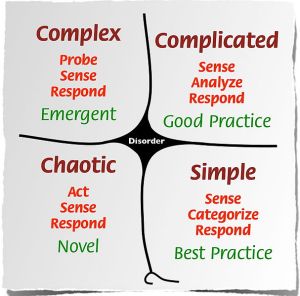
How to strengthen innovation – good practice vs. emergent practice

The Cynefin FrameworkThe last week of June I had the privilege of attending a three-day training event with Dave Snowden, founder of Cognitive Edge and “mental father” of the Cynefin framework. For me this was a great experience and although I had read a lot of stuff around complexity (also by Dave), there were still many new insights I got. Some things were new, others just became clearer. One thing that I knew but that was becoming more pronounced during the training is the differentiation between best/good practice and emergent practice. Continue reading →

Monitoring and Results Measurement: ideas for a new conceptual framework

In this post I want to share with you an idea of a new conceptual framework for monitoring and results measurement (MRM) in market system development projects. To manage your expectations, I will not present a finished new framework, but a model I have been pondering with for a while. The model is still in an early state but it would be great to harness your feedback to further improve on it. Indeed, what is presented here is based on everything I have learned in recent years from a large number of practitioners that contributed to the discussion on Systemic M&E, my work in the field, but particularly also from the guest contributions here on my blog by Aly Miehlbradt and Daniel Ticehurst and the intense discussions on MaFI. The ideas are strongly based on the learning from the Systemic M&E Initiative and also apply the seven principles of Systemic M&E, although I am not doing this explicitly. Continue reading →

Results Measurement and the DCED Standard: a commitment to move forward

We now need to start a constructive discussion on how a truly systemic Monitoring and Results Measurement (MRM) framework could look like (as Evaluation does not play a big role in the current discussions, I am adopting the expression MRM and avoid the M&E). In this post, I will take up the discussions on MRM and the DCED Standard for Results Measurement from the two guest posts by Aly Miehlbradt and Daniel Ticehurst and will add from a discussion that runs in parallel on the very active forum of the Market Facilitation Initiative (MaFI). I will also add my own perspective suggesting that we need to find a new conceptual model to define causality in complex market system. Based on that, in my next post, I will try to outline a possible new conceptual model for MRM. Continue reading →

Presenting the Systemic M&E Initiative at MPEP Seminar

MPEP SeminarI will be presenting the Systemic M&E Initiative at the upcoming MPEP Seminar on Thursday, April 25 in Washington DC. You can either participate in person or via Webinar. More information on the event and the possibility to register can be found here.

The presentation will have two parts. In the first part, I will present a general introduction to systems and complexity and why this is relevant for our work in development. In the second part, I will feature the seven principles we derived from the practitioner discussions during the Systemic M&E initiative.

ODI paper on planning and strategy development in complex situations

ODI just published a great paper by Richard Hummelbrunner and Harry Jones titled “A guide for planning and strategy development in the face of complexity.” It is a great piece that takes  the discussion around harnessing complexity for more effective development to a much more concrete, practicable and practitioner friendly level.

In the relatively short (12 pages) and easy to read paper, Hummelbrunner and Jones introduce complexity, name the biggest challenges in the face of complexity, propose three core principles to face them, and even showcase a number of tools that can be applied in these situations.

Continue reading →

Guest Post: Daniel Ticehurst with a critical reply on the DCED Standard

Daniel TicehurstAfter submitting a long comment as a reply to Aly Miehlbradt’s post, I could win Daniel Ticehurst to instead write another guest post. Daniel’s perspective on the DCED Standard nicely contrasts with the one put forward by Aly and I invite you all to contribute with your own experiences to the discussion. This was not originally planned as a debate with multiple guest posts, but we all adapt to changing circumstances, right?

Dear Marcus and Aly, many thanks for the interesting blog posts on monitoring and results measurement, the DCED standard and what it says relating to the recent Synthesis on Monitoring and Measuring changes in market systems.

Continue reading →

Guest Post: Aly Miehlbradt on the DCED Standard and Systemic M&E

Aly MiehlbradtThis is a guest post by Aly Miehlbradt. Aly is sharing her thoughts and experiences on monitoring and results measurement in market systems development projects. She highlights the Donor Committee for Enterprise Development (DCED) Standard for Results Measurement and its inception as a bottom-up process and draws parallels between the Standard, her own experiences, and the recently published Synthesis Paper of the Systemic M&E Initiative.

In one of Marcus’s recent blog posts, he cites the SEEP Value Initiative paper, “Monitoring and Results Measurement in Value Chain Development: 10 Lessons from Experience” (download the paper here), as a good example of a bottom-up perspective that focuses on making results measurement more meaningful for programme managers and staff. Indeed the SEEP Value Initiative was a great learning experience, and is just one example of significant and on-going work among practitioners and donors aimed at improving monitoring and results measurement (MRM) to make it more useful and meaningful. The DCED Results Measurement Standard draws on and embodies much of this work and, also, promotes it. In fact, the lessons in MRM that emerged from the SEEP Value initiative came from applying the principles in the DCED Results Measurement Standard.

Continue reading →

Paradigm shift and the (non) future of schools

I want to share some of my Sunday reading and listening with you.

First a blog post by Dave Algoso on his blog “Find What Works”: in the article Kuhn, Chambers and the future of international development he talks about paradigm shifts from science to international development. This is interesting as I myself and many around me are saying that a paradigm shift is needed in international development that appreciates the complexities of the environments we work in. Algoso features two posts by Robert Chambers where he sketches out how such a new paradigm could look like (direct links here and here)

Secondly, a TED talk by Sugata Mitra about the future of schools and learning. His basic thesis: “schools as we know them are obsolete”. One quote that particularly struck me, as the language he uses is very much the one we use when talking about development from a complexity perspective:

… we need to look at learning as the product of educational self-organization. If you allow the educational process to self-organize, then learning emerges. It’s not about making learning happen. It’s about letting it happen. The teacher sets the process in motion and then she stands back in awe and watches as learning happens.

Watch it yourself, it’s about 20 minutes: